Did Joseph Really Have a Coat of Many Colors? What the Hebrew Says
I still remember learning the story of Joseph and his brothers in Sunday School growing up. I remember watching the story played out on a flannelgraph where the main character, Joseph, was displayed in his brightly colored “rainbow” coat. I also remember going to a local theater to watch the musical, “Joseph and the Amazing Technicolor Dream Coat.” These were landmark times in my life. But were these teachings mistaken?
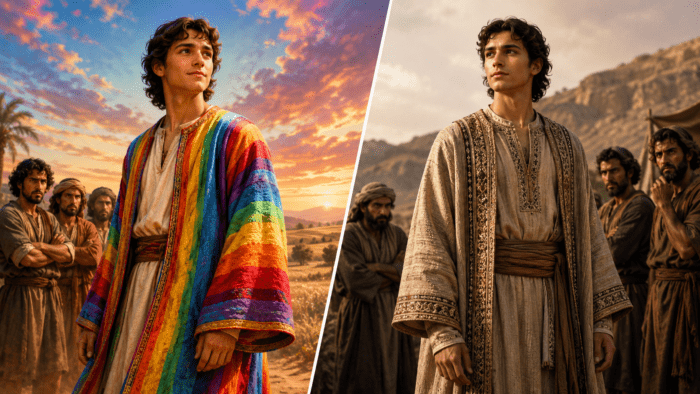
It is no surprise that most people think Joseph was the object of jealousy of his brothers because of his coat of many colors. Consider the following translations of Gen 37:3.
| ESV | Now Israel loved Joseph more than any other of his sons, because he was the son of his old age. And he made him a robe of many colors. |
| NASB | Now Israel loved Joseph more than all his sons, because he was the son of his old age; and he made him a varicolored tunic. |
| KJV | Now Israel loved Joseph more than all his children, because he was the son of his old age: and he made him a coat of many colours. |
| HCSB | Now Israel loved Joseph more than his other sons because Joseph was a son born to him in his old age, and he made a robe of many colors for him. |
All these translations seem to agree that Joseph was given a multi-colored coat, but the only problem is that the Hebrew text does not say Joseph had a coat of many colors!
The Hebrew phrase for “coat of many colors” is כְּתֹנֶת פַּסִּֽים. Historically, the reason that our English translations have something to do with colored coat is because the Greek translation of the OT translated this phrase, χιτῶνα ποικίλον, which means “various-colored coat,” or “coat of many colors.” The Latin Vulgate apparently also did not understand what the Hebrew word meant because he followed the Greek translation with tunicam polymitam.
You might say, well maybe the Greek and Latin translators got it right, and it should be multi-colored?
Probably not the case. For the same Hebrew phrase is found in 2 Samuel 13:18-19 for a long-sleeved tunic. Interestingly, this passage is clearly in context of royalty, and this tunic is specifically described as, “for thus the virgin daughters of the king dressed.” As some have noted, this may indicate that this kind of robe was representative of royalty. The Greek translator in this case translated the same Hebrew phrase as χιτὼν καρπωτός, which can be translated “coat reaching the wrists.” So no “coat of many colors” translation in 2 Samuel.
In addition, although the LXX translates Genesis 37:3 as “coat of many colors,” other Greek translations of that day do not. For example, Aquila’s translation of the OT uses ἀστράγαλον “down to the ankle(s),” and Symmachus’ translation uses χειριδωτόν, “a tunic with long sleeves.”
This evidence has led to a few of the newer translations translating this phrase as something other than “coat of many colors.” I would suspect that as translations are updated, these translations will become more common.
| CSB | Now Israel loved Joseph more than his other sons because Joseph was a son born to him in his old age, and he made a long-sleeved robe for him. |
| NET | Now Israel loved Joseph more than all his sons because he was a son born to him late in life, and he made a special tunic for him. |
| NIV | Now Israel loved Joseph more than any of his other sons, because he had been born to him in his old age; and he made an ornate robe for him. |
All this to say that the idea that Joseph had a coat of many colors, which led to his brother’s envy, appears to be a mistaken notion. The brothers were envious, but that was because Joseph was given a privileged place in his father’s eyes, even though he was the youngest. He was the son of Rachel, the favorite wife, and he was the son of Jacob’s old age. This led to Joseph being privileged above his brothers. The coat did indeed signify this special status, but the coat is not described as being multi-colored. Time to change some of our flannelgraphs.

Peter Goeman
Peter serves at Shepherd's Theological Seminary in Cary, NC as the professor of Old Testament and Biblical Languages. He loves studying the Bible and helping others understand it. He also runs The Bible Sojourner podcast and Youtube channel.
3 Comments
Stephen
Thank you for this biblical research. I came upon it only because of the loss of our beloved Dolly Parton who passed away yesterday at age 80.
My favorite song of hers is the “coat of many colors.” This led me to inquire about the biblical meaning of the coat.
The research here in no way diminishes the beauty and meaning of Dolly’s song that I play on my guitar. Dolly started out very poor so her mother actually sewed together a multi colored coat of patches of fabric so that she would have a winter coat. That’s what the beautiful song is about.
May Dolly Rest.
Ian Gebauer
Quite an interesting article, as all others of your making. Thank you!
Karole
But it’s so much more fun for Sunday school kids to use lots of colors on that coat!!
I have thought about how if Jacob hadn’t gotten tricked out of marrying Rachel first, Jospeh would have been his firstborn with all of the status, privileges and inheritance of that. It’s like God made that up to him in Egypt.
Thanks for sharing your knowledge with us.