Who Was Ahasuerus in the Book of Esther?
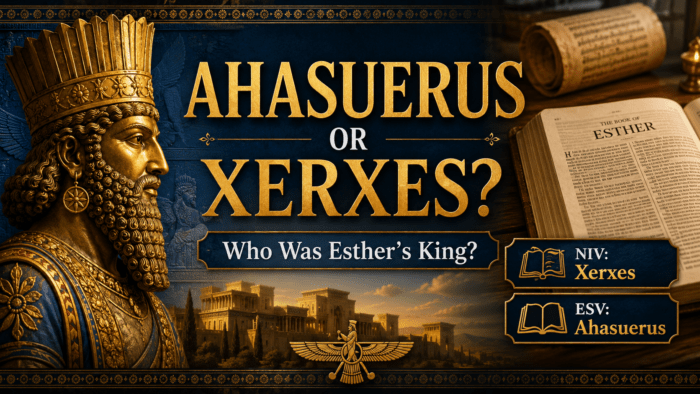
Sometimes comparing Bible translations raises interesting questions. Consider how the NIV and ESV introduce the king in Esther 1:1:
| Translation | Esther 1:1 |
|---|---|
| NIV | “This is what happened during the time of Xerxes…” |
| ESV | “Now in the days of Ahasuerus…” |
At first glance, these translations seem to identify two different kings. Was Esther married to Xerxes or Ahasuerus?
Ahasuerus, Xerxes, or Artaxerxes?
The Hebrew text calls the king אֲחַשְׁוֵרוֹשׁ (ʾAḥašwērōš), traditionally rendered Ahasuerus in English. This Hebrew form corresponds to the Old Persian name Xšayāršā, which Greek writers rendered as Xerxes. The ESV therefore preserves the form found in the Hebrew text, while the NIV uses the king’s more familiar historical name.
It is not that the king possessed two unrelated names. Rather, the same Persian name took different forms as it passed into Hebrew and Greek:
- Old Persian: Xšayāršā
- Hebrew: ʾAḥašwērōš (Ahasuerus)
- Greek: Xerxēs (Xerxes)
Thus, both translations identify the same ruler: Xerxes I, the son and successor of Darius the Great, who ruled the Persian Empire from 486 to 465 BC.
The situation becomes slightly more complicated, however, when we examine the ancient Greek version of Esther. The Septuagint identifies the king as Ἀρταξέρξης (Artaxerxes)! Josephus follows this Greek tradition in his retelling of Esther. But Artaxerxes is almost certainly a mistaken identification by the translators of Esther. The Old Persian name Artaxšaçā, from which Artaxerxes derives, cannot satisfactorily explain the Hebrew name Ahasuerus. By contrast, the linguistic connection between Ahasuerus and Xerxes has much stronger explanatory power. Moreover, Ezra 4:5–7 places Ahasuerus between Darius I and Artaxerxes I, the precise historical position occupied by Xerxes I.
Where Xerxes Fits in Persian History
The following table places Xerxes within the broader succession of Achaemenid kings. Exact accession dates can vary slightly depending on the chronology being followed.
| Persian ruler | Approximate reign |
|---|---|
| Cyrus II—the Great | 559–530 BC |
| Cambyses II | 530–522 BC |
| Bardiya—Smerdis | 522 BC |
| Darius I—the Great | 522–486 BC |
| Xerxes I—Ahasuerus (Esther) | 486–465 BC |
| Artaxerxes I | 465–424 BC |
| Xerxes II | 424 BC |
| Sogdianus | 424–423 BC |
| Darius II | 423–404 BC |
| Artaxerxes II | 404–358 BC |
| Artaxerxes III | 358–338 BC |
| Arses | 338–336 BC |
| Darius III | 336–330 BC |
This sequence also corrects a common mistake: the ruler who succeeded Cyrus the Great was Cambyses II, not Cambyses I.
When Did Esther Live?
Daniel was taken to Babylon in 605 BC and lived into the reign of Cyrus the Great, after Persia conquered Babylon in 539 BC. The events of Esther took place several decades later, during the reign of Xerxes I.
Esther 1 begins in the third year of Xerxes, approximately 483 BC. Esther became queen in his seventh year, around 479 BC, and Haman’s plot occurred during his twelfth year, around 474–473 BC. The book therefore fits naturally within the first half of Xerxes’s reign.
After Xerxes died, his son Artaxerxes I became king. Ezra’s return to Jerusalem in Ezra 7:1 occurred during the seventh year of Artaxerxes, commonly dated to 458 BC—roughly fifteen years after the events described near the end of Esther.
This chronology helps us appreciate Esther’s place within biblical history:
- Daniel ministered during the transition from Babylonian to Persian rule.
- Esther became queen during the reign of Xerxes I.
- Ezra returned to Jerusalem under Artaxerxes I.
- Nehemiah later served the same Artaxerxes as his cupbearer.
Ahasuerus and Xerxes Are the Same King
The NIV and ESV are not contradicting one another. They have simply taken different approaches to the king’s name:
- Ahasuerus represents the Hebrew form found in the biblical text.
- Xerxes represents the familiar Greek-derived name used in most historical discussions.
Both refer to Xerxes I, son of Darius I and king of Persia from 486 to 465 BC.
The identification of Esther’s king as Artaxerxes in the Septuagint and Josephus represents an ancient alternative tradition, but the linguistic and chronological evidence strongly favors Xerxes I.
One final clarification is necessary. Daniel 9:1 mentions another Ahasuerus as the father of Darius the Mede. That individual cannot be Xerxes I, and the identification remains difficult. His appearance does not necessarily prove that “Ahasuerus” was a general Persian throne name; it simply shows that the biblical name occurs in more than one historical setting.
Thus, when the NIV says Xerxes and the ESV says Ahasuerus, they are speaking about the same Persian king.

Peter Goeman
Peter serves at Shepherd's Theological Seminary in Cary, NC as the professor of Old Testament and Biblical Languages. He loves studying the Bible and helping others understand it. He also runs The Bible Sojourner podcast and Youtube channel.