Did Joshua 21 Fulfill the Land Promise to Israel?
Should we expect God to bring Israel back to the promised land someday? Some Christians argue that Joshua 21:43–45 settles the question. God gave Israel all the land He promised, everything was fulfilled, and there is no reason to expect a future fulfillment of the land promise.
I’ve seen this argument frequently in discussions online. And I understand why the passage might initially seem convincing. Joshua uses comprehensive language about God’s faithfulness. But does that mean every aspect of the land promise was exhausted during the conquest? We need to look carefully at both the promise itself and the context of Joshua.
What Did God Promise Abraham?
The land promise begins in Genesis 12:7, where God tells Abram, “To your offspring I will give this land.” Genesis 13:15 adds an important detail: the land would belong to Abraham and his offspring “forever.”
Genesis 15:18 specifies the boundaries, extending from the river of Egypt to the Euphrates. God also identifies the peoples whose land would be given to Abraham’s descendants, including the Jebusites. Keep them in mind. They will become important when we consider Israel’s conquest.
Then Genesis 17:7–8 describes the covenant as everlasting and identifies “all the land of Canaan” as “an everlasting possession.”
Two observations are straightforward. God promised a specific land to Abraham and his descendants, and He described that possession as everlasting. Those details fit naturally with the expectation that Israel still has a future in the land. Any interpretation claiming otherwise needs to account for both the geographical specificity and the enduring nature of the promise.
Does Joshua 21 Settle the Issue?
Christians who reject a future land promise for Israel commonly respond in two ways. Some understand Canaan as a type pointing forward to the whole world or the new creation. On that reading, the land promise finds its ultimate fulfillment in something greater, shared by all God’s people. That approach deserves its own discussion.
The argument we are considering here is different. In this view, God already fulfilled the land promise through Joshua, so nothing remains to be fulfilled. Many have argued this, but Gary DeMar is probably the one I’ve seen cited most.
Joshua 21:43–45 says that God gave Israel all the land He had sworn to their fathers. They possessed it, settled there, and received rest from their enemies. Verse 45 concludes, “Not one word of all the good promises that the LORD had made to the house of Israel had failed. All came to pass.”
That is strong language! For some people, this language is absolute and settles the debate entirely. But we need to remember strong language still has a context. For example, although Philippians 4:13—“I can do all things through Christ”—is often used as an absolute assessment, it is referring to the believer’s contentment, not powerful ability. Similarly, the absolute language of Matthew 7:1 doesn’t prohibit every kind of judgment. The surrounding context determines how we understand those statements. We need to exercise the same care with Joshua 21.
An Everlasting Covenant Continues to Operate
Before examining Joshua’s context, consider how God communicates through His covenants. The covenant with Noah provides a helpful comparison. In Genesis 9:15–16, God promises never again to destroy all flesh with a flood and calls this an everlasting covenant.
Would we say that because God has kept that promise for thousands of years, He has now fulfilled His obligation and is free to flood the whole earth again? Of course not. His past faithfulness gives us confidence that He will continue keeping His word.
The same consideration matters for the Abrahamic covenant. God’s faithfulness in giving Israel the land during one period of history does not cancel an everlasting commitment. Even if Israel had possessed every inch of the promised territory under Joshua, we would still need to reckon with the promise’s enduring character. God’s covenants reveal His faithfulness across generations.
Joshua and Judges Describe Land Still Unconquered
The land’s geographical dimensions are problematic for those who would say the promise was already fulfilled. The boundaries were to extend to the Euphrates, a boundary repeated in Joshua 1:4. We cannot simply assume that Israel possessed that entire territory by the end of Joshua’s life.
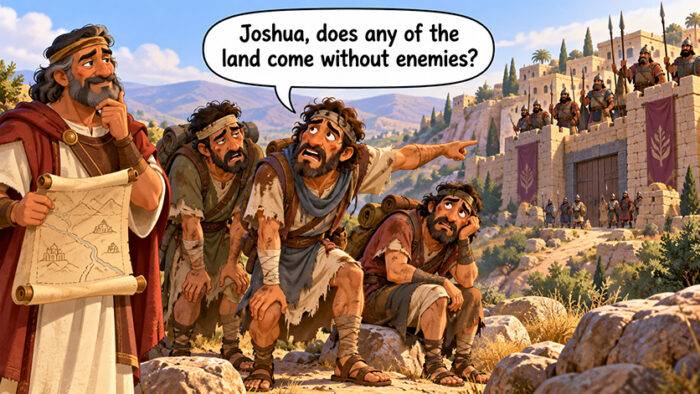
In fact, Joshua 13:1 explicitly says, “There remains yet very much land to possess.” The following verses identify unconquered regions, including Philistine territory and areas toward Lebanon. God then instructs Joshua to allot the land to Israel while promising to drive out its inhabitants (Josh 13:6–7).
Notice the order. The land was to be allotted even though significant portions remained unconquered. Receiving an allotment and occupying every part of it were distinguishable realities.
DeMar argues that because Joshua 21 comes after the descriptions of the boundaries and unconquered land, we should understand the land as possessed by that point. But the intervening chapters primarily describe the distribution of tribal allotments. They do not narrate a new campaign in which all the remaining territory was conquered. The order of the chapters cannot establish something the narrative never reports. It is a massive argument from silence.
Furthermore, Judges makes the problem even clearer. The book opens after Joshua’s death (and after Joshua 21) with Israel asking who should fight the Canaanites (Judg 1:1). Then we encounter a repeated description of Israel’s failure to drive out the inhabitants.
Benjamin did not drive out the Jebusites from Jerusalem (Judg 1:21). Remember that they were specifically included in Genesis 15. Manasseh, Ephraim, Zebulun, Asher, and Naphtali also failed to drive out various peoples (Judg 1:27–33).
Dan’s situation was particularly telling. The Amorites forced the tribe into the hill country and prevented it from coming down into the plain (Judg 1:34). That is difficult to reconcile with the claim that Israel already enjoyed complete possession of every promised region.
Furthermore, God had explicitly said the conquest would proceed gradually: “Little by little I will drive them out from before you, until you have increased and possess the land” (Exod 23:30). Deuteronomy 7:22 explains that removing the inhabitants too quickly would allow wild animals to multiply against Israel.
An initial military victory followed by a longer process of occupation was consistent with God’s stated plan. We must read Joshua 21 with that expectation in mind.
The Law Anticipated Exile and Restoration
There is another problem with treating Joshua 21 as an exhaustive fulfillment of every promise. Before Israel entered Canaan, the law already anticipated national disobedience, exile, and restoration (Lev 26:40–45; Deut 4:25–30; 30:1–10).
Deuteronomy 30 is especially clear. God would gather His scattered people, bring them into the land their fathers possessed, and circumcise their hearts so that they would love Him.
Had all of that happened by Joshua 21? Israel had not even experienced the anticipated exile, much less the restoration that would follow it. These promises were already part of God’s revelation, but their fulfillment remained ahead.
Consequently, “all came to pass” cannot mean that every promise God had ever made concerning Israel’s future was now completed. The statement must be understood within the particular circumstances Joshua is describing.
The Prophets Still Expected Israel’s Restoration
The prophets confirm that the conquest did not exhaust God’s promises concerning Israel and the land.
In Jeremiah 33:23–26, God answers those who claim He has rejected His people. He appeals to His established order of day and night and promises mercy and restored fortunes for the descendants of Abraham, Isaac, and Jacob. Centuries after Joshua, God’s covenant commitments remained operative.
Amos 9:14–15 is even more explicit. Israel would rebuild ruined cities, inhabit them, plant vineyards, and enjoy their produce. God then declares, “I will plant them on their land, and they shall never again be uprooted out of the land that I have given them.”
That is a promise of future, enduring restoration to the land, spoken long after Joshua’s conquest. Someone may attempt to explain it through a typological interpretation, but that returns us to a separate debate. Appealing to Joshua 21 alone does not resolve what Amos promises.
What Does Joshua 21 Mean?
It is not enough to explain what a passage cannot mean. We also need to explain what it does mean.
Joshua 21 celebrates God’s complete faithfulness in bringing Israel to this point. He had brought them into the land, defeated the opposing forces in the conquest, and enabled them to settle in their inheritance. Every part of that success testified to His reliability.
Think of the conquest in two stages. The initial campaigns broke the major military opposition and established Israel in Canaan. The tribes then needed to occupy their individual allotments and drive out the remaining inhabitants. God had faithfully accomplished what He promised in bringing them through the first stage. His faithfulness provided every reason to trust Him as they proceeded.
This thought process explains why Joshua can celebrate comprehensive success while also describing territory that remains unconquered. The summary evaluates God’s faithfulness in what happened; it does not erase the work the surrounding narrative explicitly says remained.
We recognize the need to interpret comprehensive language contextually in passages like Psalm 121:7, which promises protection from “all evil.” We do not conclude that believers will never experience suffering. Likewise, we must understand Joshua’s language about God’s faithfulness alongside everything else the text tells us.
Joshua 21 gave Israel (and us) a wonderful reason to trust God. He kept His word to Israel through the conquest, just as He said He would. And He would continue to do that if they responded in obedience and continued faithfulness. Unfortunately, Israel did not continue that way, and so they never completely conquered the land that they were promised. That promise still awaits the future.
Interested in Watching a Presentation on This Issue?

Peter Goeman
Peter serves at Shepherd's Theological Seminary in Cary, NC as the professor of Old Testament and Biblical Languages. He loves studying the Bible and helping others understand it. He also runs The Bible Sojourner podcast and Youtube channel.