Some of the Errors in the King James Version
One of the reasons people hold to the King James Only viewpoint is that they are under the mistaken impression that the King James was a translation that was made without error by the translators. In this article, I want to look at the historical development of the KJV and make some specific notes about the verifiable errors that existed in the original 1611 translation, and how those were changed in future editions. Pretty fascinating stuff!
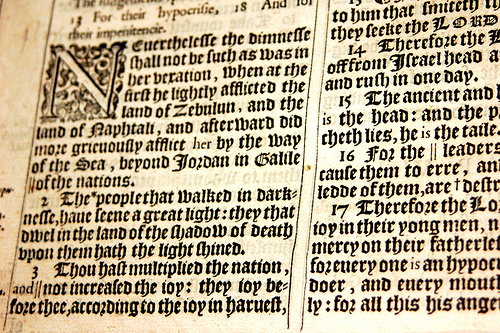
The Need to Update the King James Version
The KJV was originally published in 1611 by translators who followed 15 principles of translation. However, as the years passed, the KJV (also known as the Authorized Version) was in serious need of an update. Because English grammar and spelling had changed, in 1762, a Cambridge printer, Joseph Bentham, made many revisions. These revisions updated the spellings, punctuation, and the like. However, this version never caught on because the printing impressions were largely destroyed by fire.
In 1769, Benjamin Blayney, took Bentham’s revisions and incorporated them into his own revision of the KJV at Oxford. Blayney updated the spelling, added italics, parentheses, punctuation, and over 30,000 marginal notes on Hebrew name meanings and the like. These kinds of revisions are expected, especially in light of the vast changes that languages can undergo over that amount of time.
Significant Updates to the King James Version
Although there were many changes of a marginal nature, there were also many changes of content to the KJV. This makes sense because, perhaps surprisingly to some people, the translators had made mistakes while translating. This is an important point against those who claim the KJV is inspired and itself inerrant. If the KJV is inspired, then one would expect no errors to be found. However, there have been a multitude of changes from the 1611 KJV to the modern KJV.
The following list is a sample of the many examples that William W. Combs gives in his journal article, “Errors in the King James Version?” (DBSJ Fall 1999).
| Passage | 1611 KJV | Modern KJV |
|---|---|---|
| Jer 38:16 | So the king sware secretly | So Zedekiah the king sware secretly |
| Jer 49:1 | why then doth their king inhereit God | why then doth their king inherit Gad |
| Joel 1:16 | Is not the meat cut off before your eyes | Is not the meat cutt off before our eyes |
| Rom 3:24 | through the redemption that is in Jesus Christ | through the redemption that is in Christ Jesus |
| 1 Cor 15:41 | another of the moon | and another glory of the moon |
| 1 Tim 1:4 | rather than edifying | rather than godly edifying |
| 1 John 5:12 | he that hath not the Son hath not life | he that hath not the Son of God hath not life |
As this table clearly demonstrates, there are verifiable changes between the 1611 KJV and the modern KJV. Thus, one cannot claim that the KJV translators were inspired or without error. They were human, and did make a few mistakes. Thankfully, we are able to go back and correct those!
We Read the Bible to Understand It
My goal in this post is not to beat up the KJV. It is a great translation and a superb accomplishment in its own day and age. However, I simply want to state what I think becomes obvious when examining the evidence: if the KJV was inspired by God in 1611, then one would expect no need for “correcting” the obvious errors in it.
I can sympathize with those who hold to a strict “KJV only” position. As humans, we long for a stable foundation that will help us avoid some difficult questions. It is a zeal for the truth (in most cases) that causes people to proclaim the KJV as the only version Christians should use. However, like the Jews of Paul’s day, this is a zeal which is based on ignorance, not on truth.
When one looks at the evidence, we are faced with the fact that the KJV was a human translation, done to the best of the ability of fallible human beings. The resources that were available to the KJV translators made the KJV translation a marvelous work. However, it is not the end-all of translations. There are some English translations today that translate the meaning of God’s Word in a more accurate way than the KJV. One should not attempt to limit someone’s ability to understand God’s Word by forcing them to only use the KJV. The power of God’s Word is found in reading and understanding. May we read, understand, and do what it says!
This post is part of a series on the KJV. If you are interested in more, you can look at the other seven posts I wrote about the King James Version.

Peter Goeman
Peter serves at Shepherd's Theological Seminary in Cary, NC as the professor of Old Testament and Biblical Languages. He loves studying the Bible and helping others understand it. He also runs The Bible Sojourner podcast and Youtube channel.
4 Comments
Dwight D. Osborne
There are many errors in the KJV that Dr. Gorman doesn’t address in this brief article. The KJV actually has more errors contained in it than do the modern versions. Isaiah 14:12 contains two errors. The first error is that “Lucifer” derives from the Latin, NOT the Hebrew. Secondly, where the KJV gives him a proper name, the Hebrew is a phrase that is a titlke and NOT a proper name. The phrase is HEYLEL BEN SHAKAR. Heylel means “morningstar, “ben” is Hebrew for son and “shakar” is Hebrew for dawn. The modern versions that render the title, “morningstar, son of the dawn” are correct. The passage in Isaiah 14 also is more than a historical account of the fall of satan but also serves as a foretelling of the devil’s right-hand man in the 7-year tribulation, the antichrist. A second error is in Luke 1:35. I’m astounded that the pro-choice crowd hasn’t jumped on this verse to defend abortion. The baby Jesus at conception is referred to as a “THING” when we know full well that even at conception He was a Person and in the image of God. A third error reflects the anti-Semitism and replacement theology of the time period beginning with the 2nd century patristic fathers and continues even through today. Christ was resurrectesd on the Feast of Firstfruits. However, because of the attitudes of so-called Christians, they didn’t want th resurrection to be associated with a Jewish feast daybecause they looked upon the Jews as “Christ-killers”, not realizing that they and we are just as guilty of His death. And according to the Bible, God the Father is just as responsible as is also Christ Himself. So what did they do? They associated it with a pagan day dedicated to the worship of Ishtar, goddess of fertility which explains why today the egg and rabbit are the symbols. Anoter error is found in 1 John 5:7 where the manuscript evidence ONLY contains the phrase “For there are three that testify:” The rest of the verse in the KJV was added by Erasmus who to his credit kept a promise made to the catholic hierarchy though he recognized the addition did not belong. And there’s another error in Daniel 10:1, also in the NKJV, that doesn’t exist in the Hebrew text: “but the time appointed was long”. The phrase in question is rendered correctly in the NIV and NASB and it concerns a “great war.” Christians tend in many cases to practice biliolotry in worshiping the Book itself rather than the God of the Book. And more errors could be pointed out but these are sufficient.
autistic anglican
the message you see earlier was directed to Clayton Smith
Clayton Smith
First off I am not a KJB only person,?more like preferred/best, and TR/Majority text/Byzantine type text only. More on the specifics of that latter. Whenever someone brings up certain words or passages in the KJB they say are in error, or mistranslated? When a deep dive into the root word, and it’s etymology it is always perfectly fine as is! For the OT there is a reason that Orthodox conservative Jewish Rabbis for the last 4 centuries would tell there non-Hebrew speaking Jews to read the KJB OT? Now for the controversy over modern bibles, and the textual differences in the NT? Most modern bibles come from what is known as the Alexandrian type text, primarily these two the Codex Vaticanus, and the Codex Sinaiticus. The problem is that there is a great deception pertaining to them, which it seems like almost everyone has blindly accepted them as authentic? When the opposite is true, they have both been deemed to fraudulent documents long ago! Several organizations, and individuals have done deep research into the works of Erasmus at his historic library museum, as well as the works of all the rest of the reformers to the 47 of the KJB. They discovered that not only did Erasmus, and the rest of the reformers have considerably more manuscripts than what is thought, but more than we have today. Because the Catholic Church went around destroying Biblical texts, just like they persecuted( including the attempted bombing assassination of King James, his advisers, and the translators) all of those who dared to put the word of God into the common man’s hands. Erasmus had been to every library, school, Church, and monastery throughout Europe, the Mediterranean, Middle East, and even went to Antioch, Syria. Where he obtained an early 2nd century AD manuscripts, with no missing verses, phrases, passages etc. The Vaticanus was supposedly discovered in 1475 by the Catholic Church in the Vatican with no prior history ( oh that’s not a red flag 🚩 at all)? While Erasmus was putting together the Greek NT, he declared the Vaticanus to be a fraudulent document, and rejected it. This was known by all of the reformers, who rejected it as well. Hence why it was not used in the production of any of the reformed era Bibles, English, or otherwise. So fraudulent, fake, forged manuscript #1! The Sinaiticus was supposedly discovered in 1844 by Constantine Tischendorf( who was a known money 💵 hungry liar 🤥, and thief), but was created by Constantine Simonides( he had witnesses) in 1840. The 19th century scholar Dean John Burgon was able to physically examine the Sinaiticus in person, and he knew immediately that it was a forgery! Also David Daniels of Chick Publications has evidence with independent chemical testing, showing that the ink is 19th century! So fraudulent, fake, forgery #2! Then you have scholarship, modern scholars are considerably inferior to the reformed era scholars. So in comparison the average scholar today has about 8 or so years of higher education, and may know one ancient language somewhat? The reformed era scholars from Erasmus to the 47 of the KJB, would start their education at 4-5 years of age, and by 6-8 years of age they were fluent in Hebrew, Greek, and Latin. Besides their native languages, they would go on to learn many other languages, most knew 8-10. They were experts in Biblical studies, languages, literature, history, cultures etc! They knew more before they were teenagers, than adult scholars of today, and would literally make them look like children, infants even. In addition to the Hebrew, and Greek, as the KJB translators tell us in the preface that they used the early ancient Bibles examples being: the Syriac mid-2nd Century AD, and the Old Latin 90-130 AD. All these match up together with the Traditional text, and the KJB. This doesn’t even count the quotes of the early Church leaders in the first 4 centuries, and those quotes do not match the Alexandrian type.
Autistic Anglican
Can you provide a li st of sourcse to bback up your claims? i have tried for years to find any evidence for these claims & came up empty handed & i have even used alternative languages & web browsers that are based in countries where Catholicism isn’t common like Russian & using Yandex while checking in Korean using Naver. Thank You & GOD Bless