Did the Prophets Understand What They Said? (1 Peter 1:10-12)
Sometimes it is claimed that prophets in the Old Testament did not fully understand their own prophecies. This is often used as an argument for sensus plenior, which is the idea of finding a “fuller meaning” behind the text—a meaning which the original author may not have known.
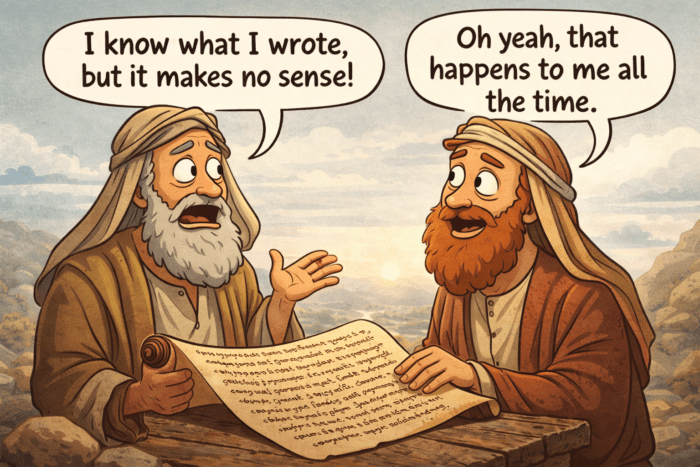
One of the key texts used to support the idea that the prophets did not fully understand their own prophecies is 1 Peter 1:10–12:
10 Concerning this salvation, the prophets who prophesied about the grace that was to be yours searched and inquired carefully, 11 inquiring what person or time the Spirit of Christ in them was indicating when he predicted the sufferings of Christ and the subsequent glories. 12 It was revealed to them that they were serving not themselves but you, in the things that have now been announced to you through those who preached the good news to you by the Holy Spirit sent from heaven, things into which angels long to look. (ESV, cf. NASB, NET)
Based on translations like these, some argue that the prophets did not fully understand the content of their prophecies about Christ. In fact, some go so far as to suggest that the prophets may not even have known that the person they were writing about was the Messiah. But that conclusion is not necessary (indeed, it ends up being quite problematic!). Rather, this passage can be understood another way.
A Better Understanding of 1 Peter 1:11a
They inquired into what time or what circumstances the Spirit of Christ within them was indicating (1 Pet 1:11a, CSB; cf. NIV, KJV)
If the CSB is correct here, then Peter is not saying the prophets were unclear about the subject matter of their prophecies. Rather, he is saying they were unclear about the timing and circumstances of fulfillment. In other words, the prophets understood what God had revealed, but they longed to know when those things would happen and under what circumstances they would come to pass.
So why is there such significant disagreement about how to understand this verse?
The issue centers on a Greek phrase in 1 Peter 1:11: τίνα ἢ ποῖον καιρόν. For most readers, the important thing to know is simply this: the phrase can legitimately be understood in more than one way. One option is to take it as referring to “what person or time.” Another option is to understand both parts of the phrase as describing the “time,” giving the sense of “what time or what circumstances.” In other words, the grammatical question is whether Peter is talking about a person and a time, or about the nature of the time itself.
Those who take the pronoun τίνα as referring to a person often argue that it would be unusual for two similar descriptive words to modify the same noun in this context. That is a fair observation. However, some Greek grammarians have noted that this may simply be a case of repetition for emphasis (e.g., Robertson and BDF). In support of that possibility, one may point to Acts 7:49, which uses a similar kind of parallel wording with the same adjectives, though there the words occur with closely related nouns. There is also a similar example in Dionysius (non-biblical Greek), which has the expression, “what and what manner of road is this?” (On the Sublime, 13.2, Aristotle XXIII, 199). So grammatically, there is good reason to say that either reading is possible.
Important Biblical Considerations
But grammar is not the only thing that matters. There are also biblical and theological considerations that should be weighed.
First, the prophets often indicate that they did not understand the timing of their prophecies (cf. Dan 12:4, 9, 13; Ezek 12:27; Zeph 3:20). This fits very well with the idea that Peter is saying they were searching for when these things would happen.
Second, it is unlikely that the prophets did not know their prophecies dealt with the Messiah. In many Old Testament passages, that seems quite clear from the context. It is difficult to believe that the prophets could speak so specifically about the coming King, Servant, or Deliverer and yet not know that they were speaking of the promised Messiah.
Third, the broader context of 1 Peter 1:10–12 highlights the contrast between the time of the Old Testament prophets and the time of New Testament believers. Peter’s emphasis is that the prophets ministered for a future generation. That means an emphasis on time would fit the flow of the passage very naturally.
Finally, it should also be remembered that communication is successful only when the receiver understands the communicator. In his book on Hermeneutics, Walt Kaiser has noted that the prophets repeatedly demonstrate that they understood the message God gave them. He gives several reasons for this.
- The prophets were aware of the results of their prophecies.
Examples of this are in abundance. Jonah knew his prophecy would lead to the opportunity for salvation for Nineveh (Jonah 4:3). Micaiah knew his prophecy would be displeasing to the kingly court (1 Kgs 22:15). - The prophets were aware of the implications of their prophecies.
Amos shows prophetic certainty of judgment (Amos 7:1-6). Jeremiah shows similar sensitivities (Jer 7:16; 11:14; 14:11). - The prophets were told things that were humanly impossible to know.
This is obviously one of the signs of a true prophet (cf. Deut 18:19-22). Elisha (2 Kgs 6:9) and Ezekiel (Ezek 8:3–11:25) are both listed as examples by Kaiser, but there could be many more. - The prophets related their predictions to contemporary events and circumstances. Obviously, the prophets had to understand their prophecies in order to provide appropriate application to the current generation. Amos 3:7-8 indicates that God intentionally reveals His will clearly to the prophets so that there is no question about God’s power and control.
God communicated through the prophets in a clear and understandable way. That is not to say the prophets understood every implication or every future application of what they wrote. There is a difference between understanding the message itself and understanding every detail about how and when God would bring it to pass. The prophets may not have known all the particulars, especially regarding timing, but that is very different from saying they did not understand the content of their own prophecies.
This is a very important point about prophecy. In order for prophecy to accomplish its purpose, it must be understandable. It must be verifiable. It also had to speak meaningfully to the generation that first received it. For prophecy to do that, it needed to be understood by its original audience.

Peter Goeman
Peter serves at Shepherd's Theological Seminary in Cary, NC as the professor of Old Testament and Biblical Languages. He loves studying the Bible and helping others understand it. He also runs The Bible Sojourner podcast and Youtube channel.