Ezekiel 40–48: Will There Be Millennial Sacrifices?
How could anyone believe that animal sacrifices will return after Jesus offered Himself as the perfect sacrifice for sin? Isn’t that a denial of the sufficiency of the cross?
This objection frequently comes up in discussions of the millennial kingdom. Some Christians regard the idea of future sacrifices as so obviously wrong that they dismiss it without much discussion. But the question deserves careful attention. We need to understand what Scripture says about future worship and what the sacrificial system actually accomplished.
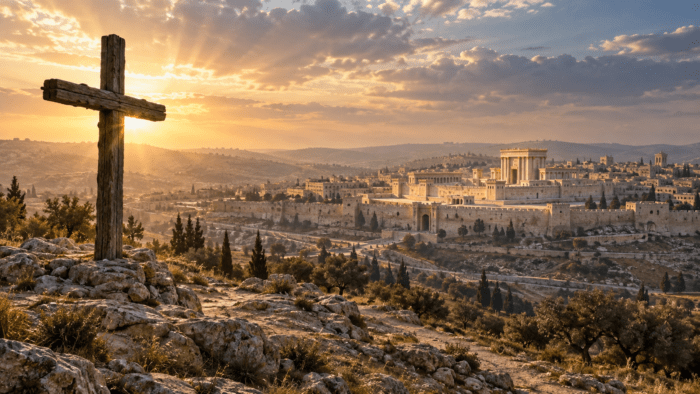
I believe there are too many passages that discuss a future temple to simply dismiss it out of hand. Furthermore, I believe when we understand the sacrificial system, future sacrifices are completely compatible with Christ’s finished work.
Which Temple Are We Talking About?
First, we need to distinguish a temple rebuilt in unbelief from the temple associated with the Messiah’s kingdom. Sometimes people miss that 2 Thessalonians 2 describes a future event when the “man of lawlessness” enters the temple and declares himself to be god. This has not happened yet, so it awaits a future time. This will be prior to the establishment of the kingdom of Christ.
Obviously, the temple connected with the rebellion described in 2 Thessalonians 2 belongs to a different setting than the temple described in Ezekiel 40–48 or Isaiah 2. Recognizing that a temple will be rebuilt does not mean Christians should support worship that rejects Jesus as Messiah. Christians can believe something will happen without approving of it. And in this case, there will be a future temple that promotes false worship before there is a temple that promotes true worship.
The Future Temple as a Common Biblical Theme
Sometimes this issue is dismissed as though everything depends on one obscure passage in Ezekiel. However, as I have discussed elsewhere, the prophets repeatedly describe a future temple. For example, Isaiah 2:2–3 portrays the nations streaming to the house of the Lord in Jerusalem. Haggai 2:7–9 promises greater glory for God’s house and peace in that place. Zechariah 6:12–13 identifies the coming Branch as the One who will build the temple of the Lord and rule on His throne.
I understand that some interpreters take these descriptions symbolically. But we still have to ask how the original audience would have understood them. These promises were given to people familiar with an actual temple, actual priests, and actual worship in Jerusalem.
Ezekiel adds extensive detail to that expectation. His final nine chapters describe the temple, its priesthood, and its sacrifices. Whatever interpretation we adopt must account for those details. Simply calling the passage symbolic does not resolve the issue, which multiple prophets support.
Three Views of the Millennial Sacrifices
If there will be a future temple, it stands to reason that there will be future sacrifices. But how would future sacrifices work now that the all-sufficient sacrifice of Christ has taken place on the cross? In working through this subject, I have found Matt Waymeyer’s chapter in To Seek…to Do…and to Teach: Essays in Honor of Larry D. Pettegrew especially helpful. I have summarized much of his presentation in summarizing the three views as follows.
1. The Symbolic View
According to this view, the sacrifices describe future worship using language familiar to Ezekiel’s audience. The offerings themselves will not literally occur. This view appeals to those who see significant theological problems with the sacrificial system continuing post-crucifixion.
We must readily admit that Scripture uses symbolic language. The question is whether the text gives us a reason to understand these particular descriptions that way. Ezekiel could have described praise, thanksgiving, and worship without providing sacrificial regulations. The Psalms demonstrate that such language was readily available and used often.
There is also a problem of consistency for those who affirm a literal temple but symbolic sacrifices. Why should the building be understood literally while the worship prescribed within it is understood figuratively? That distinction needs support from the passage itself.
2. The Memorial View
This is probably the most common view among those who embrace millennial sacrifices. The memorial view understands the sacrifices as reminders of Christ’s completed work. Just as the Lord’s Supper directs our attention to His death without repeating it, future sacrifices would look back to the cross. Old Testament sacrifices anticipated Christ; millennial sacrifices would commemorate Him.
That is a reasonable comparison, and I certainly would not rule out a memorial function. However, two problems keep me from accepting it as a complete explanation.
First, Ezekiel never explicitly identifies remembrance as the purpose of these offerings (in contrast with the Lord’s Supper). Second, he repeatedly says that the offerings make atonement (Ezek 43:20, 26; 45:15, 17, 20). They accomplish something. A purely memorial explanation does not adequately account for that language, in my opinion.
3. The Ceremonial Cleansing View
The third view, which I find most compelling, understands the sacrifices as providing ceremonial cleansing for worship in God’s presence.
This requires us to reconsider a common assumption: that every Old Testament sacrifice was motivated in some respect by personal sin. However, this is a significant misunderstanding of the sacrificial system. There certainly were sacrifices and cases where sin was dealt with, but it also included expressions of thanksgiving, fellowship, dedication, purification, and consecration—all of which were independent of sin.
When teaching through Leviticus, I have found that this line of thinking surprises people. We are accustomed to thinking about sacrifice almost entirely in terms of sin and salvation. But Leviticus also addresses how people and objects become ceremonially suitable for worship.
For example, childbirth resulted in ceremonial uncleanness and required purification offerings (Lev 12). However, nobody would say that giving birth was a sinful act (at least I hope not!). Yet there were sacrifices that were required to prepare the woman for worship. Similarly, someone recovering from a serious skin disease underwent prescribed cleansing rituals (Lev 14). Ceremonial uncleanness and personal wrongdoing were not identical categories, yet sacrifices were involved in both cases.
That distinction is essential to understanding this view of Ezekiel’s sacrifices.
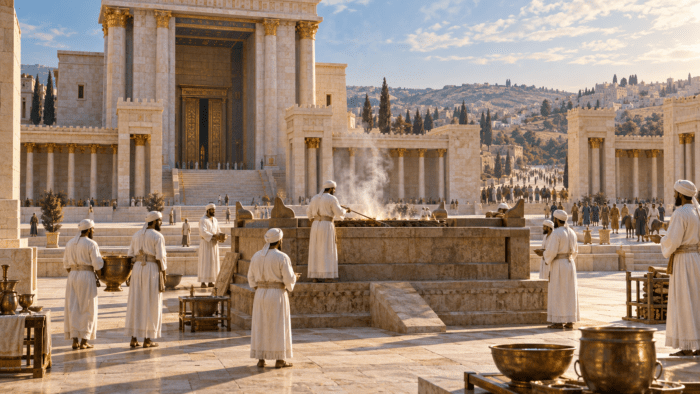
What Does “Atonement” Mean in Ezekiel?
Someone may balk at the ceremonial cleansing view because Ezekiel mentions the idea of “making atonement” as part of the sacrifices. Most people assume making atonement has to relate to sin and forgiveness. However, the Hebrew verb commonly translated “make atonement” can describe purification or consecration as well as atonement associated with forgiveness. Context determines what is being accomplished.
Consider, for example, that in Ezekiel 43:20 and 26, atonement is made for the altar. Obviously, the altar has not committed a sin! It needs cleansing and consecration for sacred use. Ezekiel 45:20 likewise describes atonement for the temple in connection with human error. To put it succinctly, inanimate objects can not sin, so the atoning sacrifices for the altar and temple cannot be to forgive the sins of the altar or temple. These make sense as sacrifices of worship and consecration.
The references to atonement for the people in Ezekiel 45:15 and 17 require careful interpretation. On the one hand, these references could relate to the forgiveness of sins. But, as Waymeyer argues, the surrounding emphasis on purification supports understanding these offerings as providing ceremonial cleansing. The passage does not explicitly state that they result in forgiveness.
That fits the broader context. Ezekiel has already promised Israel cleansing and restoration under the new covenant (Ezek 36:25–27; 37:23). Yet the priests must still teach the distinction between the holy and the common, and between the clean and the unclean (Ezek 44:23).
How Does This Fit with Hebrews?
Hebrews is clear that Christ’s sacrifice accomplished what animal sacrifices never could. Animal sacrifices could neither take away sins nor cleanse the conscience (Heb 9:9; 10:4, 11). Christ, however, offered Himself once for all, securing eternal redemption and perfecting His people forever (Heb 9:12; 10:14). Nothing can supplement His sacrifice.
However, Hebrews also recognizes that the earlier sacrifices accomplished external, ceremonial cleansing (Heb 9:13–14). The ceremonial cleansing view maintains that distinction: Christ secures eternal redemption, while Ezekiel’s offerings address ritual defilement in an earthly sanctuary.
There are also significant omissions in Ezekiel’s description. Although the vision gives extensive sacrificial instructions, it never mentions the annual Day of Atonement, the high priest, the veil, the mercy seat, or the ark of the covenant. These features were central to the Mosaic system and to Hebrews’ explanation of Christ’s work.
Waymeyer argues that these omissions reflect Christ’s fulfillment of those features. Jesus is the great High Priest who entered the heavenly sanctuary and offered the perfect sacrifice for His people. The forgiveness anticipated by the Day of Atonement has been accomplished. Its absence from Ezekiel’s vision therefore supports the compatibility of future sacrifices with Christ’s finished work. This will not be a reinstatement of the old Mosaic covenant.
But what about Hebrews 10:18, which says there is “no longer any offering for sin”? Waymeyer acknowledges that this deserves careful consideration, especially because this could signal the end of the sacrificial system as a whole. Waymeyer points to the logic of the verse: because sins have been forgiven, an offering to obtain forgiveness is no longer required. The statement specifically concerns an offering for sin.
That qualification matters. According to the ceremonial cleansing view, millennial sacrifices will not provide forgiveness for sins already dealt with through Christ’s death. They will provide purification and consecration for worship in the earthly sanctuary. Consequently, Waymeyer argues that Hebrews 10:18 does not necessarily exclude sacrifices serving those other purposes (i.e., not for sin). Their existence would not imply that Christ’s sacrifice was deficient, because they would not attempt to accomplish what He has already accomplished.
It seems that the ceremonial cleansing view offers the most faithful way to harmonize Ezekiel 40–48 with Hebrews 9–10. These sacrifices would enable people who have not yet been glorified to worship in God’s presence while fully preserving the sufficiency of Christ’s redemptive work. Further study may refine our understanding, but acknowledging that need does not prevent us from reaching a conclusion. We have good reason to affirm both the future sacrifices Ezekiel describes and the complete sufficiency of Christ’s sacrifice as emphasized by Hebrews.
Paul’s Participation in Acts 21
One additional passage deserves attention, but is often ignored in this discussion. In Acts 21, James and the Jerusalem elders encouraged Paul to join four men in purification and pay their expenses. The head shaving and vow naturally point to a Nazirite vow, whose completion involved sacrifices, including a sin offering (Num 6:13–21).
Paul agreed. Luke even mentions the offering to be presented for each man (Acts 21:23–26). Although the narrative does not record the completion of those sacrifices, Paul’s willingness to participate in the sacrificial system post-Christ seems inconsistent with those who insist such an action would be an offense to Christ.
This event occurred well after Christ’s death and resurrection. If any involvement in animal sacrifice necessarily denied the cross, the actions of Paul, James, and the Jerusalem elders become difficult to explain.
I have had some people tell me that Paul was wrong. Of course, apostles could make mistakes. But the passage does not condemn this decision. In fact, it would not just be Paul’s error, but James and the elders of Jerusalem as well. We should be cautious about declaring it sinful simply because it creates difficulty for our theological system.
Acts 21 does not establish every detail of millennial worship. It does, however, challenge the assumption that all sacrificial participation after the cross must constitute a rejection of Christ.
Understanding Sacrifice Before Rejecting It
Contrary to many who are antagonistic to the idea of a millennial temple, I do not believe the expectation of millennial sacrifices is heretical. The ceremonial cleansing view offers a coherent explanation of how those sacrifices can function while fully affirming Christ’s sufficient work.
Much of the objection depends on treating all sacrifices as though they accomplish the same thing. Leviticus gives us reason to question that assumption, and Ezekiel requires us to examine it carefully.
Before dismissing future sacrifices, we need a biblical understanding of sacrifice itself. My humble encouragement to serious Bible students would be to study the sacrificial system in Leviticus. Studying Leviticus may clarify this discussion more than we expect.
Interested in Watching or Listening to a Discussion on the Millennial Sacrifices?

Peter Goeman
Peter serves at Shepherd's Theological Seminary in Cary, NC as the professor of Old Testament and Biblical Languages. He loves studying the Bible and helping others understand it. He also runs The Bible Sojourner podcast and Youtube channel.
One Comment
David Pitman
Excellent! I can see an evangelistic object lesson in the millennial sacrificial system.